Monster Train looks generous because it constantly offers new cards, units, upgrades and artifacts. The trick is learning that you should not accept all of them. Strong runs are usually built around a small number of reliable units, a clear scaling plan and a deck that lets you draw the important pieces quickly.
These Monster Train tips are aimed at helping beginners win more consistently while still being useful as you climb Covenant ranks or start experimenting with The Last Divinity.
Do Not Take a Card Just Because the Game Offers One
Skipping cards is one of the strongest habits you can develop.
Every unnecessary card makes it slightly harder to draw the unit, buff or damage spell you actually need. If neither reward fits your strategy, take the gold and keep your deck focused.
A smaller deck full of upgraded cards is generally more dependable than a huge collection of average ones.
Build Around a Main Floor
Most successful beginner decks benefit from having one main defensive floor where your strongest units do the majority of the work.
Put durable units toward the front and your most valuable attackers behind them. A strong floor should eventually be able to kill common waves while also surviving long enough to fight bosses during Relentless combat.
Other floors can still be used for disposable units, utility effects or weakening enemies before they reach your main formation.
Understand What Your Deck Is Scaling
Early fights can be won with basic damage. Later fights cannot.
Your deck needs some way to become dramatically stronger during a battle. That may come from Rage, Regen, Spikes, Incant, Frostbite, Harvest, Reform, Gorge or another clan mechanic.
When evaluating a new card, ask whether it strengthens the engine you already have instead of simply asking whether the card looks powerful on its own.
Upgrade a Few Important Cards Heavily
Merchant upgrades are usually more valuable when concentrated.
A key attacker with Multistrike can transform an entire run. A spell with lower Ember cost, extra magic power or Holdover can become something you rely on every turn.
Spreading gold across ten mediocre cards often produces a weaker deck than turning three or four important cards into excellent ones.
Remove Cards That Stop Helping You
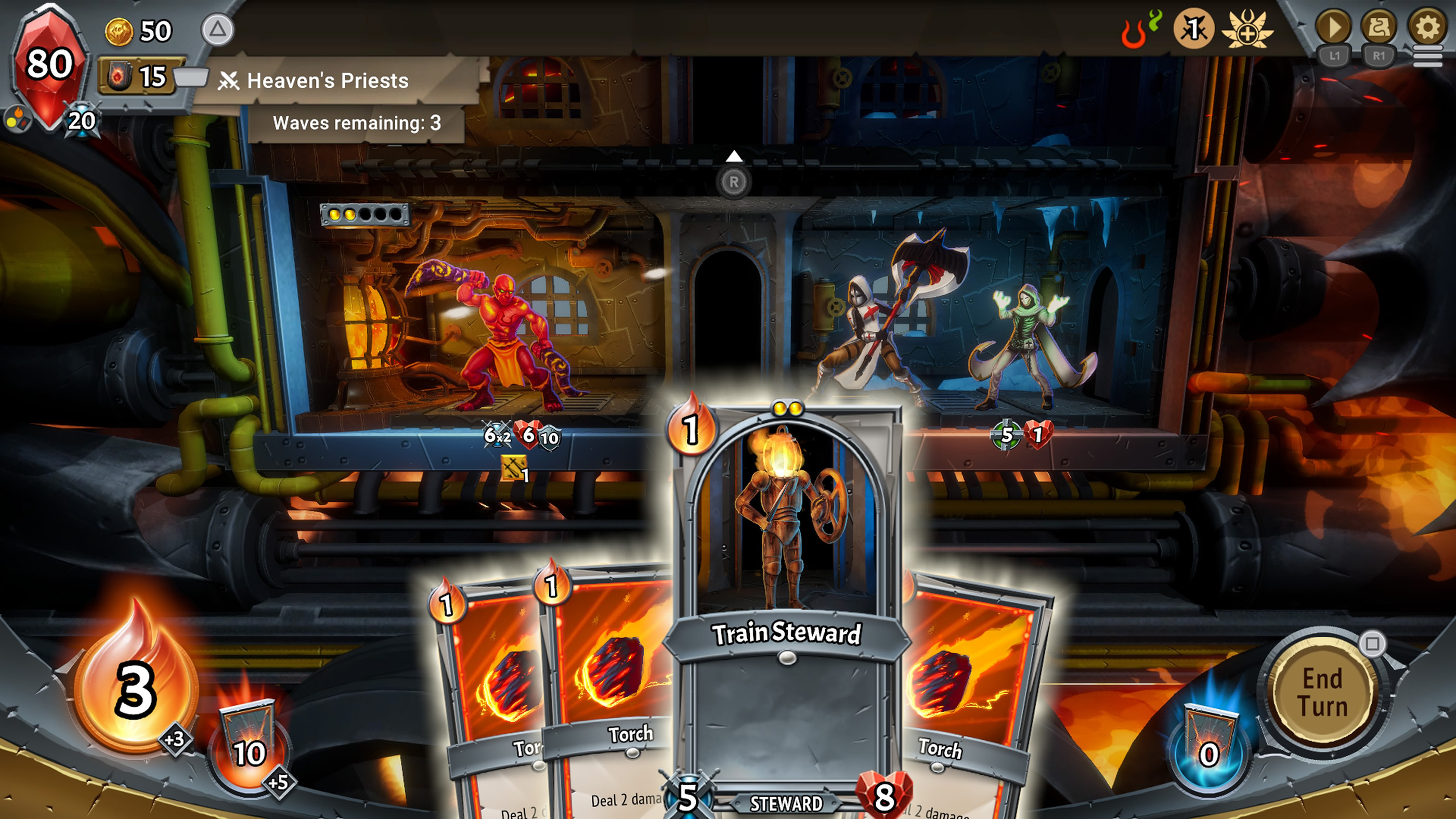
Train Stewards and weak starter spells are useful during the opening battles, but many become dead draws later.
Use Unstable Vortex locations and shop removal services to cut cards your strategy no longer needs. The exact removal order depends on your deck. Sometimes an unused spell is more harmful than a Steward because a Steward can at least be played once and leave the draw cycle for that battle.
The goal is not simply to own fewer cards. The goal is to make every future draw better.
Do Not Take Too Many Banner Units
Banner units have special draw priority, which is extremely useful when you keep your roster focused.
If you draft too many of them, they begin competing with each other for those early draws. That can leave your main tank or damage dealer buried deeper in the deck than you wanted.
For many runs, a small core of two or three important banner units is easier to build around than a crowded army.
Use the Combat Preview Every Turn That Matters
The combat preview is not just a convenience. It is one of your best planning tools.
Before ending the turn, check whether any enemies survive, whether an important unit dies and how much damage could reach the Pyre. One extra spell or a small unit placed in front can sometimes prevent a surprising amount of damage.
Think About Backline Enemies
High attack enemies hiding behind tanks are among the most dangerous units in Monster Train.
Build at least one answer for them. Sweep, targeted spells, piercing damage, Frostbite and other forms of direct backline removal can prevent fragile but dangerous enemies from repeatedly reaching your defensive line.
A deck that only deals huge damage to the first enemy is often less safe than it looks.
Multistrike Is Powerful Because Scaling Multiplies With It
Multistrike is one of the strongest unit upgrades because every point of attack you add becomes more valuable.
A unit with 60 attack and one hit deals 60 damage. Give that same unit another strike and the same attack scaling is effectively used twice.
That is why powerful runs often combine Multistrike with Rage, permanent stat growth or repeated buffs.
Quick Is Excellent When Your Damage Is Already High
Quick allows a unit to attack before the enemy strikes back.
It becomes especially strong on Sweep units or high damage attackers that can eliminate several enemies before they ever get a chance to hit your frontline.
Quick does not replace damage scaling, though. Killing enemies first only works if your unit actually has enough attack to finish them.
Plan Your Route Before Choosing a Side
After battle, look at the whole upcoming route rather than only the first icon.
A Merchant of Steel is valuable when your important units still need upgrades. A Merchant of Magic matters more for spell heavy decks. Unstable Vortexes help clean your deck, while Pyre Remains can repair damage from earlier mistakes.
Choose the route that solves your current weakness instead of automatically chasing every artifact or unit banner.
Trials Are Good, but Read Them First
Optional battle trials can provide valuable rewards and extra gold, especially during the early part of a run.
Do not activate one automatically. Some modifiers directly punish a particular deck. Extra armor might be harmless for a build with huge damage, while extra enemy attack could destroy a fragile setup.
Take trials when you understand the additional risk and know your deck can handle it.
Learn What the Final Boss Will Do Early
Monster Train tells you which version of the final boss you are heading toward.
Read that information near the beginning of the run and keep it in mind as you build. A strategy that relies completely on stacking buffs, for example, may need adjustments against an enemy designed to interfere with them.
Building specifically for the boss is much more reliable than discovering the problem at the last battle.
Your Pyre Is a Resource, Not a Perfect Score
Taking a little Pyre damage is not always a disaster.
Sometimes allowing one weak enemy through is better than spending several valuable cards protecting against a tiny amount of damage while your main strategy still needs setup.
What matters is avoiding repeated leaks and preserving enough Pyre health to survive the run.
Use Disposable Units With Purpose
Train Stewards, Imps, Dregs, Morsels and other expendable units can absorb attacks, activate triggers or buy your main floor more time.
A low value unit placed in front of an important attacker can prevent a huge hit. Just make sure it does not occupy capacity that your real formation needs.
Do Not Waste Floor Capacity
Each train floor has limited capacity, so unit size matters as much as raw stats.
Before drafting another large unit, decide where it will actually fit. A powerful monster that prevents your tank and main attacker from sharing the same floor may make the whole deck harder to use.
Capacity upgrades after major bosses can be excellent when your strategy depends on assembling a larger formation.
Choose Boss Rewards Around the Deck You Already Have
After major bosses you can usually improve a fundamental resource such as Ember, card draw or floor capacity.
More Ember helps expensive decks. Extra draw is excellent when your card quality is high and you want to cycle quickly. More capacity matters when your main floor cannot fit the formation you are trying to build.
There is no single reward that is always correct.
Do Not Ignore Duplication
Duplicating an upgraded card also copies its upgrades, which can be incredibly strong.
Instead of drafting a second mediocre attacker, you may be able to duplicate the excellent unit you already invested in. The same applies to a cheap Holdover spell or a key scaling card.
Duplication is often one of the cleanest ways to strengthen a deck without introducing weaker pieces.
The Last Divinity Players Should Respect Pact Shards
If you are playing with The Last Divinity enabled, Pact Shards give you access to stronger upgrades, unit infusions and other powerful rewards, but they also strengthen enemy encounters.
Do not collect shards simply because they are available. Take them when the power you gain is worth the additional danger they add to later fights.
Going above 100 Pact Shards is also what opens the path to the additional Last Divinity encounter after Seraph, so prepare the deck for a much tougher finish.
Clan Pairings Work Best When They Cover Each Other
Your primary and allied clans do not need to use identical mechanics.
A good pairing often lets one clan provide damage while the other supplies survivability, card draw, Ember generation or utility. The strongest combination is usually the one that fixes what your current deck lacks rather than the pairing that looks strongest in isolation.
Monster Train Beginner FAQ
What should I remove first?
Usually weak starter cards that no longer contribute to your strategy. Train Stewards are common removal targets, but an irrelevant spell that keeps cycling through the deck can sometimes deserve removal first.
How many units should I take?
There is no fixed number, but beginners often perform better with a small core of reliable banner units rather than drafting every monster offered.
Should I always take Multistrike?
It is extremely powerful on a unit that already has or can gain strong attack, but it is less impressive on a unit that never scales.
Should I put my strongest floor at the bottom?
Not always. Higher floors give you more time to weaken enemies before they reach your main formation. The correct floor depends on the encounter, your setup speed and what the boss is doing.
Why do my decks feel inconsistent?
The most common causes are taking too many cards, drafting too many banner units or failing to remove weak starter cards. Focus on fewer important pieces and upgrade them heavily.
Is Covenant 25 mostly luck?
Random rewards matter, but consistency improves dramatically when you learn deck trimming, route planning, scaling and boss preparation. Strong players regularly win difficult Covenant runs because they build around the options they are actually given.
Comments
No comments yet. Be the first to share your thoughts!