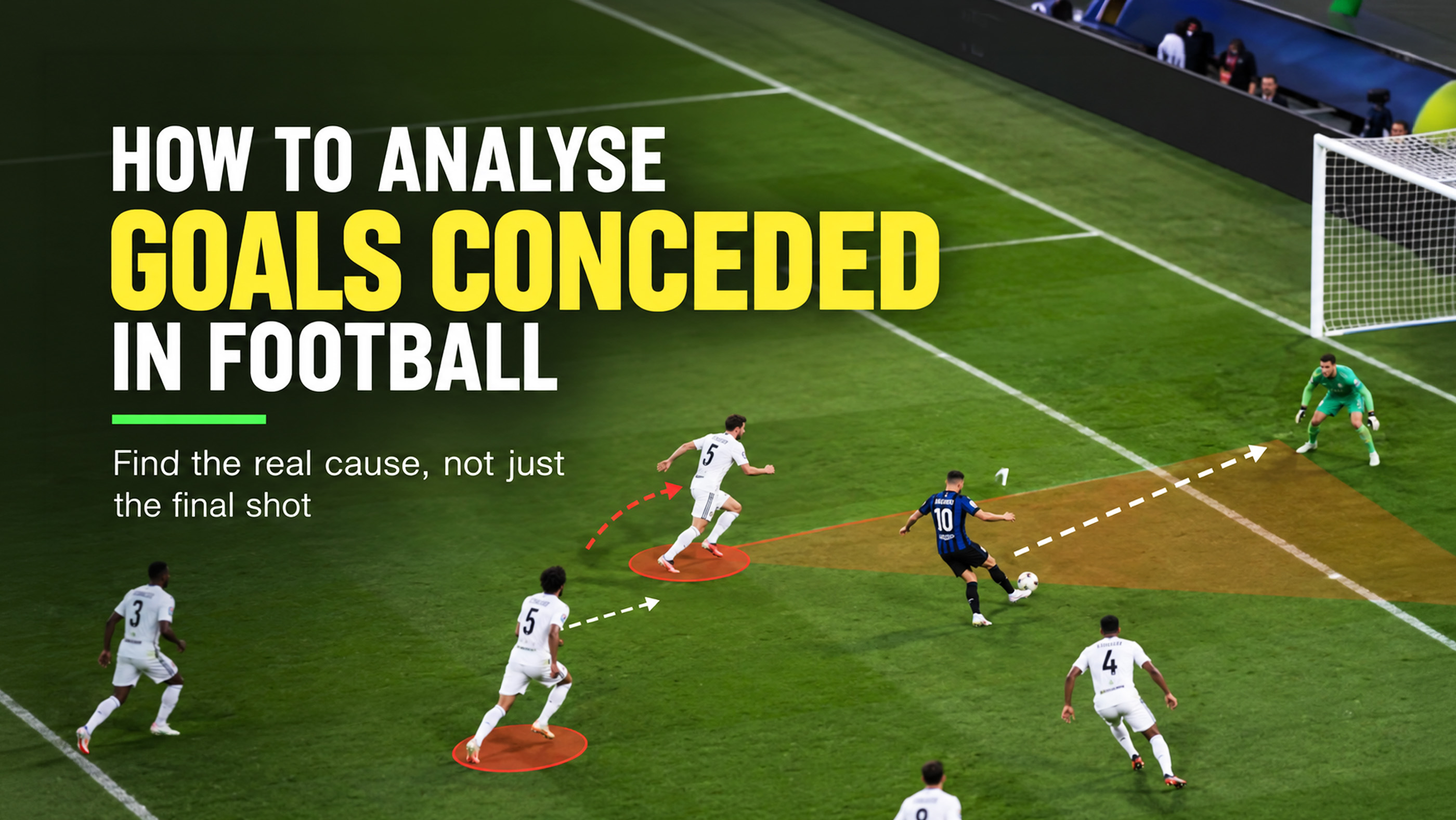
A striker receives a pass inside the penalty area and scores. The centre back was too far away, so it must be his fault. Or was it?
Perhaps the midfielder failed to track a runner. Perhaps the full back was pulled out of position. Maybe the entire problem started ten seconds earlier, when the team lost possession with too many players ahead of the ball.
This is why analysing goals conceded in football requires more than watching the final shot. The objective is to understand how the chance developed, which defensive decisions influenced it and what the team could realistically have done to prevent it.
Start Before the Goal, Not at the Shot
When reviewing a conceded goal, rewind to the beginning of the attacking sequence. This could be a turnover, a goalkeeper distribution, a throw in or a period of sustained possession.
Watch the sequence once without pausing. Then review it again, focusing exclusively on the defending team. Ask yourself three questions:
- How did the opposition gain possession or begin the attack?
- Where did the defending team first lose control of the situation?
- What allowed the opposition to create a shooting opportunity?
The earliest mistake is not necessarily the decisive one. A team might lose possession in midfield but still have enough players behind the ball to defend successfully. The important task is identifying which actions turned a manageable situation into a dangerous chance.
Identify the Type of Goal Conceded
Before examining individual players, classify how the chance was created. Different types of goals reveal different defensive demands.
| Goal Type | What to Analyse |
|---|---|
| Counterattack | Possession loss, recovery runs, rest defence and protection of central spaces |
| Through Ball | Pressure on the passer, defensive line position, tracking and cover |
| Cross | Pressure on the crosser, marking inside the box and far post protection |
| Cutback | Wide defensive positioning, runners arriving centrally and protection around the penalty spot |
| Set Piece | Marking assignments, blocking movements, delivery area and second balls |
| High Press Turnover | Passing options, receiving positions, pressing traps and decisions under pressure |
| Long Range Shot | Pressure on the shooter, screening, defensive positioning and goalkeeper visibility |
| Second Ball or Rebound | Reaction after the first contact, positioning and responsibility for loose balls |
This classification is a starting point, not the explanation itself. Two goals from crosses might have completely different causes. One may result from poor pressure on the winger, while another comes from a missed marking assignment at the far post.
Find the Moment the Defensive Structure Breaks
One of the most useful techniques is to pause the footage at the moment the opposition gains a clear advantage.
Look at the distances between defenders and midfielders. Is the defensive line compact? Is there pressure on the ball? Are passing lanes into dangerous areas protected? Can the defenders see both the ball and the attacking runners?
A defensive problem often begins when two players respond differently to the same situation. One centre back steps forward to challenge an attacker while the other drops deeper. A midfielder presses the ball but nobody covers the space behind him.
These moments can create gaps even when every player appears to be working hard.
Pressure, Cover and Balance
A useful way to evaluate the defensive structure is to examine three basic responsibilities.
- Pressure: Is someone close enough to influence the player on the ball?
- Cover: Is another defender positioned to protect the space behind the pressing player?
- Balance: Are the remaining defenders protecting dangerous areas and potential passing options?
When one of these elements disappears, the opposition may find a route toward goal. The analyst should determine whether the problem came from positioning, timing, communication or an effective attacking movement.
Analyse the Actions of Players Without the Ball
The most important player in a conceded goal is not always the defender challenging the shooter.
Imagine a winger carrying the ball toward the penalty area. The full back moves across to stop him. At the same time, an attacking midfielder makes a run between the centre backs and receives a pass.
The final defender may appear responsible because he was closest to the scorer. However, the more useful questions are whether the midfielder's run should have been tracked, whether the defensive line communicated the movement and whether the ball carrier was allowed too much time to pass.
Watching only the ball hides these relationships. When reviewing footage, follow the movement of the eventual scorer before the pass is played.
Examine What Happened Immediately After Possession Was Lost
Goals conceded from transitions deserve particular attention because teams are often spread across the pitch while attacking.
Look at the team's rest defence, meaning the players positioned to protect against a counterattack while their teammates are in possession.
If both full backs are advanced and only two centre backs remain against three opposition attackers, the vulnerability may already exist before the turnover.
Then examine the reaction to losing the ball. Did the nearest player apply pressure? Did teammates recover toward central areas? Was the opponent able to play forward immediately?
A team can sometimes prevent a dangerous counterattack simply by delaying the first forward pass long enough for other defenders to recover.
Separate Individual Mistakes From Tactical Problems
Not every conceded goal indicates a failure of the team's system. Sometimes a defender slips, a goalkeeper misjudges a shot or an attacker produces an exceptional finish.
The distinction matters because the solution depends on the cause.
Consider a centre back who loses an aerial duel despite being correctly positioned and supported. That may be an execution problem. If the same centre back repeatedly faces two attackers without cover, the issue is more likely to involve the team's defensive organisation.
Avoid drawing conclusions from one incident. Review similar situations throughout the match, including attacks that did not result in goals.
A Practical Example of Goal Conceded Analysis
Imagine a team playing in a 4 3 3 formation. It loses possession near the opposition penalty area and concedes a goal from a quick counterattack.
At first glance, the centre backs appear to be at fault because the striker runs between them and finishes.
A closer review reveals the following sequence:
- The attacking full back moves high up the pitch, leaving space behind him.
- A central midfielder loses possession while facing his own goal.
- The nearest teammates fail to delay the first forward pass.
- The opposition winger receives the ball with space to accelerate.
- One centre back moves wide to confront the winger, opening a central passing lane.
- The striker attacks that space and receives the decisive pass.
The goal was not simply caused by poor centre back defending. The team's attacking positioning, reaction to the turnover and defensive cover all contributed.
A useful coaching response might involve improving rest defence, adjusting the full back's positioning or practising how the nearest players react immediately after losing possession.
The correct solution depends on whether these problems occurred repeatedly and what responsibilities the team had been instructed to follow.
Use Statistics to Support the Video Analysis
Statistics can help determine whether a conceded goal reflects a recurring weakness or an unusual incident.
Useful information includes expected goals against (xGA), shot locations, opposition penalty area entries, turnovers, counterattack chances and set piece opportunities conceded.
For example, a team might concede only one goal but repeatedly allow unmarked shots from central areas. That is a warning sign even if the goalkeeper prevents further damage.
Alternatively, a team might concede from a difficult long range shot despite limiting the opposition to low quality chances throughout the match.
Remember that xG estimates the probability of a shot becoming a goal based on the characteristics included in a particular model. It does not, by itself, explain the defensive decisions that allowed the shot.
For a broader approach to combining tactical observation and statistics, Footballizer's Match Analysis guide explains how to evaluate performance using video, data and match context.
Use Match Simulations to Explore Defensive Decisions
Once you understand how a goal was conceded, the next step is to consider possible alternatives.
Could the full back have remained deeper? Would a midfielder covering the central passing lane have reduced the danger? What might have changed if the team had recovered into its defensive shape rather than pressing immediately?
Footballizer's match simulator offers a way to explore football match scenarios in an interactive setting. It can complement tactical learning by encouraging players to think about decisions, match situations and possible outcomes.
However, a simulated match is not evidence that a particular tactical adjustment would have prevented a goal in a real match. Use simulations to explore ideas, then evaluate those ideas through actual footage, coaching practice and match performance.
Turn Your Findings Into a Defensive Improvement Plan
A good analysis should lead to something the team can practise. Rather than telling defenders to concentrate more, identify the exact situation that needs improvement.
| Repeated Problem | Possible Training Focus |
|---|---|
| Opponents counterattack through central areas | Rest defence and recovery positioning |
| Strikers receive through balls behind the line | Pressure on the passer and coordinated defensive line movement |
| Unmarked attackers score from cutbacks | Penalty area coverage and tracking arriving midfielders |
| Opponents win second balls from corners | Clearance organisation and second ball reactions |
| Possession is repeatedly lost near the penalty area | Receiving angles, passing options and decisions under pressure |
Keep the feedback specific. Two or three well supported findings are usually more valuable than a long list of mistakes.
A Simple Checklist for Every Goal Conceded
Use these questions whenever you review a goal:
- Where did the attacking sequence begin?
- Was the defence organised when possession changed?
- Who applied pressure to the ball carrier?
- Were central passing lanes and dangerous spaces protected?
- Which attacking movement created the decisive advantage?
- Was the defensive line coordinated?
- Did an individual error occur, or was there a wider structural problem?
- Did the same weakness appear elsewhere in the match?
- What specific action could reduce the risk next time?
For a more complete process covering every phase of the game, see Footballizer's How to Analyse a Football Match guide. It explains how to observe team shapes, pressing, transitions, individual roles and recurring tactical patterns.
Frequently Asked Questions
The following questions address some of the most common difficulties when analysing defensive performance.
How do you analyse a goal conceded in football?
Review the attacking sequence from its beginning, identify when the opposition gained an advantage, examine the defensive structure and determine which decisions or actions contributed to the chance. Compare the incident with similar situations before deciding what needs improvement.
Who is responsible when a team concedes a goal?
Responsibility depends on the situation. A goal may involve an individual error, a tactical weakness, an effective opposition movement or several contributing factors. The nearest defender is not automatically the player most responsible.
What statistics are useful for analysing goals conceded?
Expected goals against, shot locations, penalty area entries, turnovers and set piece chances can all provide useful context. Video is still needed to explain the defensive positioning and decisions behind those numbers.
How can coaches reduce goals conceded from counterattacks?
Coaches can review rest defence, the positioning of players behind the attack, immediate pressure after turnovers and recovery runs. Training should address the specific weaknesses observed in matches.
Can a team defend well and still concede?
Yes. Excellent finishing, deflections and isolated mistakes can produce goals even when a team generally limits dangerous chances. Defensive performance should be evaluated over multiple situations rather than judged entirely by the scoreline.
Make Every Conceded Goal a Useful Lesson
The purpose of analysing goals conceded is not to find someone to blame. It is to understand what the opposition exploited, why the defensive response failed and whether the same problem is likely to happen again.
Start with the sequence, study the players away from the ball, separate tactical issues from individual execution and look for repetition. When the explanation is clear, it becomes much easier to turn a disappointing goal into a useful coaching decision.


Comments
No comments yet. Be the first to share your thoughts!