FBC: Firebreak gets much easier once you stop playing it like a conventional corridor shooter. Killing Hiss matters, but most Jobs also ask you to repair, clean, carry, activate or protect something while the Oldest House tries to make the work as unpleasant as possible.
The best crews divide attention naturally. Someone keeps the Job moving, somebody watches the dangerous approach and everybody uses their equipment instead of saving it for a perfect moment that never comes.
Play the Objective before Chasing Kills
A high kill count does not complete a Crisis by itself.
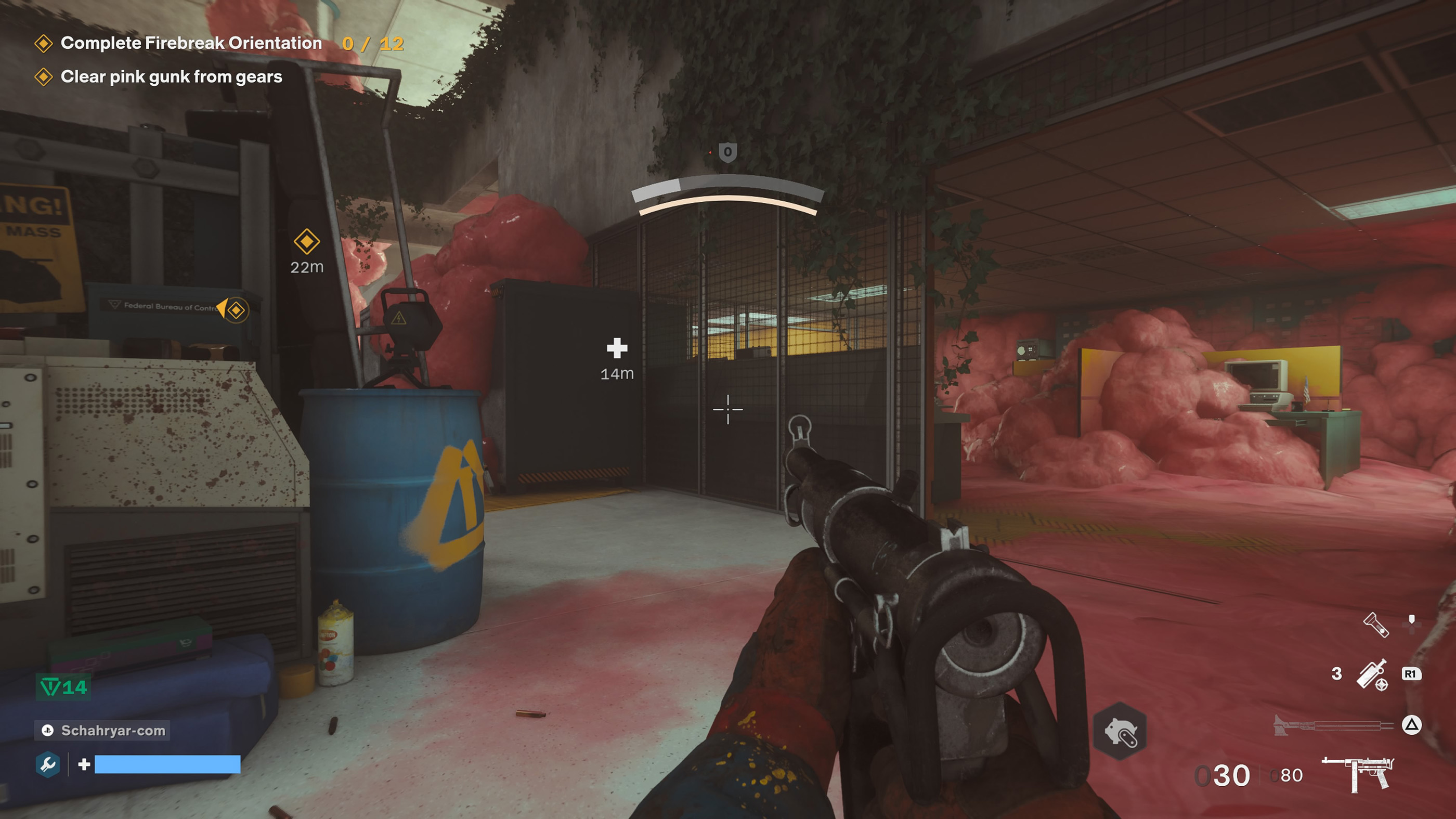
Read the Job objective and keep checking what still needs to be done. If the current wave is under control, use that breathing room to repair machinery, clean the area or advance whatever task the Crisis requires.
Recognize Safe Windows
You rarely need the entire room completely empty before working. When only a few manageable enemies remain, one player can advance the objective while the others provide cover.
Stay Close Enough to Help Each Other
Splitting up too far is one of the easiest ways to turn a manageable run into three separate emergencies.
You do not need to stand shoulder to shoulder, but teammates should remain close enough to react when somebody is pressured or downed.
Move as a Loose Triangle
A little separation gives everyone firing angles without leaving one player isolated on the other side of the room.
Use Pings Constantly
D Pad Down is one of the most useful buttons in the game.
Ping dangerous enemies, useful equipment and anything teammates need to notice quickly.
Mark the Threat before Shooting It
A dangerous elite becomes much easier to focus down when the entire team sees it at the same moment.
Build a Crew with Complementary Utility
FBC: Firebreak is built around equipment combinations rather than three players carrying identical solutions.
Look at what the other Firebreakers are bringing and fill a missing role where possible.
Do Not Duplicate Everything
Three identical loadouts may produce plenty of damage but leave the group poorly equipped for the actual Crisis.
Use Your Tool during the Job
Your special equipment is not something to save for the end of the mission.
Switch away from your weapon when the objective calls for the tool. A teammate covering you can make a few seconds of uninterrupted work much more valuable than another magazine of gunfire.
Throw Grenades before the Room Is Already Lost
Grenades are excellent for groups and chokepoints.
Use them when several enemies are entering the same space rather than waiting until they have surrounded the squad.
Watch Your Team
Explosives are much less useful when your teammate is already fighting inside the blast area. Check positioning before committing.
Deploy Equipment Early
If your current loadout includes deployable utility, establish it before the most dangerous part of the encounter.
Equipment gets more value when the squad can deliberately fight around it rather than desperately placing it after everyone is already scattered.
Keep Moving while Shooting
Standing still makes you an easy target and allows enemies to compress around your position.
Strafe while firing and gradually rotate around the combat area so you always know where your next escape path is.
Do Not Back into Unknown Space
Occasionally glance behind you before retreating. The Oldest House is full of furniture, debris and other unpleasant things to get trapped against.
Use Melee as a Finisher
R3 is useful for a target that has reached you, but do not turn every encounter into close combat.
Finish a weak enemy, immediately create distance and return to your weapon or objective.
Reload before the Next Wave
Make a habit of checking ammunition whenever the room becomes quiet.
Entering the next engagement with half a magazine is an avoidable mistake, especially when your attention will soon be divided between enemies and Crisis work.
Use Altered Augments on Important Moments
Altered Augments provide some of Firebreak's strangest and strongest abilities.
Use them when a difficult enemy arrives, a large wave converges or the squad needs immediate breathing room.
Do Not Hoard Them Forever
If the ability could prevent a teammate from going down or let the squad finish an objective safely, that is already a good use.
Learn Every Crisis before Raising the Challenge
Firebreak rewards knowledge. A Job that initially feels chaotic becomes much more manageable once you understand where the objectives are, how the rooms connect and when the dangerous waves arrive.
Use easier runs to learn the procedure before increasing the challenge.
Understand the Breakpoint Progression Changes
The Breakpoint update significantly streamlined Firebreak's core progression and onboarding, so older launch guides can describe systems that no longer behave exactly the same way.
If you are returning after a long break, review your equipment, progression and Crisis options rather than assuming the launch version still applies.
Use Voice Chat or Quick Communication
Cross platform voice chat makes coordinated runs much easier, especially with players on different systems.
If you prefer not to use a microphone, pings and the Voice Wheel still provide enough information for most ordinary Jobs.
Keep Calls Short
Say what matters now: dangerous target, objective ready, moving left, need help. Long explanations belong between encounters.
Try Endless Shift when You Understand the Core Combat
Rogue Protocol added Endless Shift, a separate roguelite mode built around escalating enemy waves.
You earn Corruption during a Shift and spend it between waves on Enhancements that can dramatically alter your weapons and abilities.
Build around What You Are Given
Do not force the same ideal setup every run. Choose Enhancements that work with the weapon and tools you currently have.
Think about Synergy
An individually modest Enhancement can become excellent when another upgrade strengthens the same mechanic.
Know When to Stop Rerolling
Chasing the perfect option can waste resources that would have improved your build immediately.
Endless Shift Gets Dangerous Quickly
Enemy combinations become increasingly difficult as a run continues.
A build that destroys early waves may still fail if it lacks survivability, crowd control or an answer to tougher elites.
Do Not Build Only for Damage
Healing, utility and control can become more valuable than another small damage increase once the arena is full of threats.
Use Temporary Enhancements in Crises
Completing Endless Shift can let some Enhancements carry into your next Crisis deployment as temporary bonuses.
If you have earned a useful carryover effect, consider following the Shift with a difficult Crisis where that bonus can make a meaningful difference.
Explore the Open House Arenas
The Open House update expanded Endless Shift with additional arenas inspired by familiar Control locations, including the Cafeteria, Aircon Room, Ranger HQ, Turntable and Ritual Lobby.
Each space changes sightlines, chokepoints and safe movement routes, so do not use exactly the same positioning strategy in every arena.
Learn the Exit Routes First
Before concentrating on damage, identify where you can rotate when the next wave pushes into your current position.
Use the Friend's Pass
Open House added a Friend's Pass feature that lets owners invite friends to join their session even if those friends do not own the full game.
That makes it much easier to assemble a regular three person crew, which is where Firebreak's cooperative systems work best.
Use Difficulty to Learn, Not to Prove Anything
FBC: Firebreak provides adjustable difficulty.
If a Job is overwhelming you before you even understand its objective flow, reduce the challenge and learn the procedure. Raise it once the team can execute the work reliably.
Common Beginner Mistakes
Playing Only for Kills
Keep advancing the Crisis objective whenever the squad creates a safe opening.
Ignoring Tools
Your specialized equipment is part of the Job, not an optional extra.
Splitting the Squad
Stay close enough to cover and revive one another.
Saving Every Grenade
Use explosives on meaningful groups before they overrun the room.
Never Pinging
Mark priority targets and important objective elements for the crew.
Reloading Too Late
Use quiet moments to enter the next fight prepared.
Standing Still
Keep rotating through safe space instead of allowing enemies to surround you.
Hoarding Augments
Use powerful abilities when they can prevent a run from getting out of control.
Ignoring Endless Shift Synergies
Choose Enhancements that strengthen one another instead of collecting unrelated bonuses.
A Reliable Crisis Routine
- Check the Job objective before combat starts.
- Look at your teammates' equipment and identify what your role can contribute.
- Ping important enemies and objective components.
- Clear enough enemies to create a safe working window.
- Advance the objective immediately.
- Reload and reposition before the next major wave.
- Use grenades and deployables before the room becomes crowded.
- Activate an Altered Augment when the squad genuinely needs the advantage.
- Stay within practical helping distance of the team.
- Repeat the objective loop instead of drifting into endless combat.
Frequently Asked Questions
Is FBC: Firebreak good solo?
It can be played without a full premade group, but its objectives and equipment are designed around cooperation, so coordinated teammates make the experience much smoother.
How many players are in a Firebreak squad?
Up to three players can work together.
What should I focus on first in a Job?
Understand the objective, then kill only enough enemies to create the space needed to keep the Crisis work moving.
Should every player use the same loadout?
Usually no. Complementary equipment gives the squad more answers to changing threats and objective requirements.
What is Endless Shift?
It is a roguelite wave based mode added with the Rogue Protocol update, where you earn Corruption and build a run using Enhancements.
Can Endless Shift Enhancements affect normal Crises?
Some earned Enhancements can temporarily carry into the next Crisis deployment after completing a Shift.
Does FBC: Firebreak have cross platform voice chat?
Yes.
Can friends play without buying the game?
The Friend's Pass introduced with Open House allows an owner to invite friends into their session even when those friends do not own the full game.
Can I change the difficulty?
Yes. The game provides adjustable difficulty settings.
What is the best beginner tip?
Stop treating every room as a deathmatch. Create space, do the work and keep the squad together.
Do the Work while Everyone Else Is Distracted
The funny thing about FBC: Firebreak is that the mundane part of the Job is often the most important. The Hiss want you to spend the entire mission shooting. Your actual goal might be cleaning, repairing or operating something while bullets and paranormal nonsense fill the room.
Good crews learn to recognize the moment when the enemies are distracted enough for somebody to get the work done. Ping clearly, use your equipment early and move the objective whenever you have an opening. That approach makes ordinary Crises faster and becomes even more important when the difficulty rises.
See our FBC: Firebreak Controls Guide for the complete PS5 and PC control layout, grenades, deployables, communication commands and Altered Augments.
Comments
No comments yet. Be the first to share your thoughts!